Equipment failure isn’t always the biggest danger in industrial environments. Often, it’s the moment maintenance begins. A machine powered down improperly can restart unexpectedly, releasing stored energy that crushes, burns, or kills. That’s where lockout tagout safety training becomes non-negotiable.
Lockout tagout (LOTO) isn’t just a procedure—it’s a system of discipline designed to isolate hazardous energy sources before service or maintenance. And training is the backbone. Without proper instruction, even experienced technicians can make fatal errors. Misjudging a residual energy source, skipping verification steps, or using the wrong lock can all lead to catastrophe.
This article breaks down what effective lockout tagout safety training entails, why it's legally mandated, and how organizations can implement it to protect workers and maintain compliance.
What Is Lockout Tagout Safety Training?
Lockout tagout safety training educates employees on how to control hazardous energy during equipment servicing or repair. It’s rooted in OSHA standard 29 CFR 1910.147, which requires employers to establish energy control programs, use written procedures, and ensure all affected and authorized employees are properly trained.
At its core, the training teaches two distinct roles:
- Authorized Employees: Workers who physically lock out machines and perform servicing. They must know how to identify energy sources, apply locks and tags, and verify zero-energy states.
- Affected Employees: Operators or nearby staff who don’t perform maintenance but need to understand why LOTO is in place and what not to do—like attempting to restart a locked-out machine.
Misclassification is a common flaw. Some companies train only maintenance staff, assuming operators don’t need it. That’s a violation. Both groups require training—just tailored to their responsibilities.
For example, in an automotive assembly plant, a robotic arm under maintenance must be isolated from electrical, pneumatic, and hydraulic sources. An authorized technician applies a personal lock, while line operators are trained to recognize the tag and never bypass it. Training ensures everyone speaks the same safety language.
Why OSHA Requires LOTO Training
Every year, nearly 120 workers die and 50,000 are injured in the U.S. due to unexpected machine startup or release of stored energy. OSHA estimates that proper lockout tagout procedures prevent 120 fatalities and 50,000 injuries annually.
The agency mandates LOTO training because energy sources are often invisible. A conveyor belt may appear off, but a coiled spring or charged capacitor can still unleash deadly force. OSHA doesn’t just require locks and tags—it requires understanding.
Key OSHA training requirements include:
- Initial training before employees are assigned LOTO duties
- Retraining at least annually or when procedures change
- Certification records kept on file
- Hands-on practice with real equipment
A 2022 OSHA citation against a food processing plant in Ohio revealed this failure: employees were trained in theory but never practiced isolating a mixer’s hydraulic system. When an untrained worker tried to clear a jam, the machine cycled—resulting in a crushed hand. The fine: $145,000. The lesson: theoretical knowledge isn’t enough.
Training must be practical, documented, and role-specific.
The 6-Step LOTO Procedure Every Worker Must Know
Effective training doesn’t just cover “what” and “why”—it breaks down the “how.” The standard LOTO process consists of six critical steps. Workers must master each.
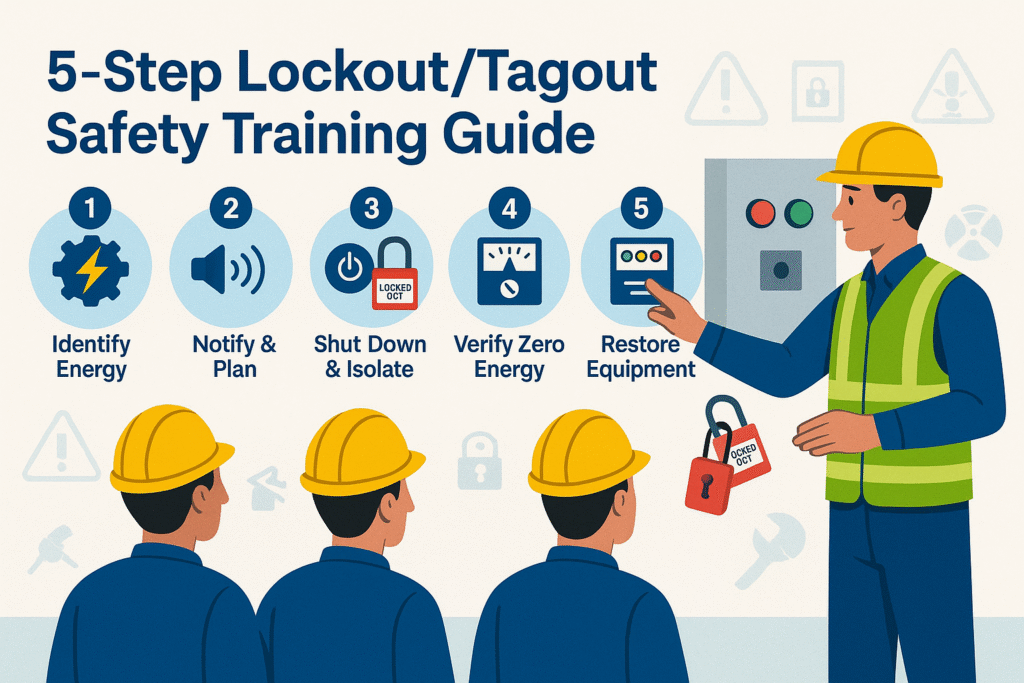
#### 1. Prepare for Shutdown Identify all energy sources: electrical, mechanical, hydraulic, pneumatic, chemical, thermal, or gravitational. Review the machine-specific LOTO procedure. Gather necessary locks, tags, and tools.
Common mistake: Assuming a single main disconnect is sufficient. In reality, multiple isolation points may exist.
#### 2. Notify Affected Personnel Alert all operators and nearby workers that a shutdown is imminent. Communication prevents panic or interference.
#### 3. Shut Down the Machine Use normal stopping procedures. Don’t bypass control circuits.
#### 4. Isolate Energy Sources Apply locks and tags to all disconnects, valves, or bleed points. Use only assigned, keyed locks—never shared.
Pro tip: Use hasp-style lockout devices when multiple workers are involved. Each applies their own lock.
#### 5. Control Stored Energy Relieve, disconnect, or block residual energy. This includes bleeding air lines, draining capacitors, or blocking elevated parts.
Real-world failure: A technician in a paper mill bypassed a bleed valve, assuming pressure had dissipated. It hadn’t. The release blew a panel across the room.
#### 6. Verify Isolation Attempt to restart the machine (via normal controls) to confirm it won’t energize. Return controls to “off” or “neutral.” This is the only way to prove the machine is truly de-energized.
Skipping verification is the most frequent violation OSHA cites. Some workers don’t want to “risk” turning a switch, fearing liability. Training must emphasize: verification isn’t optional—it’s the final safety test.
Common Training Gaps and How to Fix Them
Even companies with LOTO programs often miss critical elements. Here are recurring gaps and how to address them:
#### Gap 1: One-Time Training Without Refreshers Many train employees once and never again. OSHA requires retraining when job roles change, procedures are updated, or performance shows deficiencies.
Solution: Schedule annual drills with scenario-based testing. Simulate emergency clears or multiple-energy shutdowns.
#### Gap 2: Generic, Not Machine-Specific A broad lecture on LOTO principles isn’t enough. Workers need procedures tailored to each machine.
Solution: Develop equipment-specific checklists. Include photos, energy source maps, and lock placement diagrams.
#### Gap 3: Poor Tag Design or Use Tags that lack detail—missing names, dates, reasons—become meaningless. Worse, some workers use tags without locks, violating OSHA rules.
Solution: Use durable, standardized tags with fields for: - Worker name - Department - Date and time - Reason for lockout - Expected duration
#### Gap 4: Inadequate Group Lockout Procedures In team maintenance, confusion over who controls the system can lead to premature re-energization.
Solution: Train on group lockout best practices: - Use a central lockbox - All locks applied before work begins - Last person to remove their lock verifies the area is clear
Hands-On vs. Online LOTO Training: What Works Best?
The debate isn’t whether to train—it’s how.
Online training offers scalability. Modules can cover theory, regulations, and quizzes. Platforms like PureSafety or Vector Solutions provide LMS integration and tracking. Ideal for initial knowledge delivery.
But hands-on training is irreplaceable. Workers must: - Physically apply locks - Navigate real control panels - Practice energy dissipation - Conduct verification steps
- A hybrid model delivers the best results:
- Online module for theory and OSHA basics (30–45 minutes)
- In-person session with site-specific equipment (1–2 hours)
- Skills assessment where workers demonstrate full LOTO on a live-but-simulated machine

A manufacturing plant in Indiana reduced LOTO errors by 78% after switching from pure classroom training to a blended approach. The key wasn’t more time—it was context.
Who Needs LOTO Training and How Often?
Not everyone needs the same level of instruction.
| Role | Training Scope | Frequency |
|---|---|---|
| Authorized Employee | Full 6-step procedure, energy isolation, verification | Initial + annual retraining, plus after incidents |
| Affected Employee | Recognize LOTO, understand restrictions, know not to interfere | Initial + annual refreshers |
| Contractors | Same as authorized, plus coordination with host employer | Before site entry + per project |
| Supervisors | Oversight, audit procedures, verify compliance | Annual, with leadership drills |
Retraining isn’t just calendar-based. Trigger events include: - Procedure changes - Equipment modifications - Near-misses or incidents - Observations of non-compliance
Documentation is critical. Each training session should generate a record: who was trained, what was covered, who instructed, and proof of competency.
Building a Sustainable LOTO Safety Culture
Training doesn’t end with a certificate. It evolves into culture.
Consider a chemical plant where maintenance crews conduct weekly “LOTO walk-throughs.” Supervisors randomly audit lock applications, tag clarity, and isolation points. Workers are encouraged to stop any questionable procedure—no retaliation.
This kind of environment reduces risk because safety becomes a shared responsibility.
Keys to sustaining LOTO culture: - Leadership involvement: Executives participate in drills - Visible accountability: Post LOTO compliance rates - Employee feedback: Let workers suggest procedure improvements - Recognition programs: Reward consistent adherence
One refinery introduced a “Zero Incident Lockout” badge. Technicians earned it by completing 50 error-free LOTOs. Participation in training rose by 40%. Motivation works when it’s visible.
Final Thoughts: Training Is Your Last Line of Defense
Lockout tagout safety training isn’t a box to check—it’s a lifeline. Equipment fails. Procedures get updated. People forget. But consistent, practical, and enforced training builds resilience.
Start with clear roles. Deliver hands-on instruction. Audit regularly. Make safety visible and valued.
The goal isn’t just OSHA compliance. It’s ensuring every worker walks out the same way they walked in—safe, aware, and in control.
Implement your LOTO training with rigor, revisit it with discipline, and treat every procedure like it matters. Because it does.
Frequently Asked Questions
What is the purpose of lockout tagout safety training? The purpose is to teach workers how to safely isolate hazardous energy sources during equipment maintenance to prevent injury or death.
Who is responsible for providing LOTO training? Employers are legally responsible for providing initial and refresher training to both authorized and affected employees.
How often should LOTO training be repeated? OSHA requires retraining at least annually, and additionally when procedures change, equipment is modified, or worker performance indicates a need.
Can online courses fulfill OSHA LOTO training requirements? Online courses can cover theory, but OSHA requires hands-on practice and demonstration of skills, so in-person or on-site training is essential.
What happens if a company doesn’t provide LOTO training? Failure to provide training can result in OSHA citations, fines exceeding $100,000, increased injury rates, and legal liability after incidents.
Do contractors need LOTO training? Yes, contractors performing servicing or maintenance must be trained on the host employer’s LOTO procedures and coordinate their own locks and tags.
What’s the difference between lockout and tagout? Lockout uses a physical lock to prevent energizing a device; tagout uses a warning tag. OSHA allows tagout only if it provides equivalent protection, typically requiring additional safety measures.
FAQ
What should you look for in Lockout Tagout Safety Training: Protect Workers, Prevent Accidents? Focus on relevance, practical value, and how well the solution matches real user intent.
Is Lockout Tagout Safety Training: Protect Workers, Prevent Accidents suitable for beginners? That depends on the workflow, but a clear step-by-step approach usually makes it easier to start.
How do you compare options around Lockout Tagout Safety Training: Protect Workers, Prevent Accidents? Compare features, trust signals, limitations, pricing, and ease of implementation.
What mistakes should you avoid? Avoid generic choices, weak validation, and decisions based only on marketing claims.
What is the next best step? Shortlist the most relevant options, validate them quickly, and refine from real-world results.